

Current and Historic Sewing Pattern Companies
Several major pattern manufacturers have remained influential throughout much or all of the twentieth century and continue to serve sewing enthusiasts around the world today. Among the most recognizable are Butterick, McCall's, Simplicity, and Vogue. In recent years, both Butterick and Vogue have reissued vintage designs, reflecting the growing interest in historical and retro-inspired sewing. The companies listed below represent some of the most notable names in pattern history and provide a useful introduction for collectors and vintage sewing enthusiasts.
Advance
Advance enjoyed considerable success from the 1940s through the 1960s before disappearing from the market in the late 1960s. The company was licensed by Mattel to produce clothing patterns for Barbie dolls and also released a small range of designer collections during the 1950s. Designers associated with these special editions included Adrian, Edith Head, and Anne Fogarty.

Advance 5062; ca. 1949; Men's Shirt. View 1, Long-sleeve Shirt. View 2, Short-sleeve Shirt.
Shirt has front v Yoke with diagonal one button closing and long pointed collar. Long button cuff sleeves or short sleeves. Optional front patch pockets.
Ann Adams
Ann Adams was an American mail-order pattern company. Unlike many competitors, it was relatively slow to adopt printed tissue patterns. Some designs from the early 1960s still featured cut-to-size tissue pieces rather than printed guides.
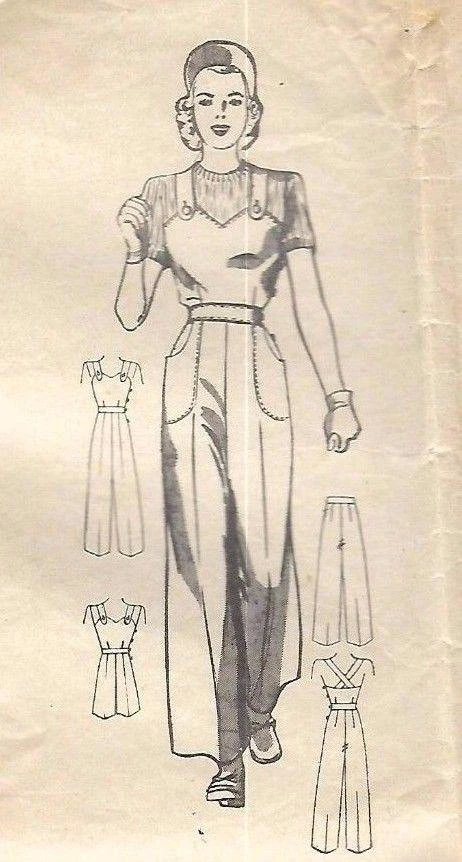
Anne Adams 4305; ca. 1940s; Overalls, Cap, Slacks and Playsuit
An interesting article on working clothes for working class people by witness2fashion
Burda
Originating in Germany, Burda patterns initially developed a reputation among American home sewers for being more challenging to use. Early patterns were produced in multiple sizes and did not include seam allowances, requiring additional preparation by the sewer. Although not generally regarded as trend-setting in design, Burda patterns became available in the United States during the 1970s, primarily through independent sewing and fabric shops.

Burda 8400; ca. 1981; Dirndl Style Dress and Apron.
Butterick
Butterick is widely considered one of the oldest pattern companies still operating today. Many of the earliest surviving commercial sewing patterns available to collectors were produced by this company. During the 1960s and 1970s, Butterick introduced its "Young Designer" collection, featuring creations by emerging fashion talents such as Mary Quant, Betsey Johnson, Jean Muir, Kenzo, and John Kloss. These patterns are now highly valued as examples of the designers' early work.

Butterick 5334; ca. 1950; Dressmaker Bathing Suit: Halter Neckline. The bathing suit to flatter the mature as well as the young figure. Princess fit with bra top & flared skirt.Halter neck bands & facing in contrast to accent the neckline. Swimsuit is lined & has attached trunks.
Hawaiian Pattern Companies
A number of businesses specialized in patterns inspired by Hawaiian fashion. Among the best-known were Patterns Pacifica and Polynesian Patterns, while other notable names included Pauloa Patterns and Kekabi Patterns. Their collections typically featured popular island-inspired garments of the 1960s and 1970s, including muumuus, shifts, cover-ups, and coordinated play sets.

Polynesian 180; ca. late 1960s or early 1970s; Women's sleeveless jumpsuit has round front neckline and "V" back neck. Sash wraps around to tie in front.
Hollywood Patterns
Hollywood Patterns is remembered for its striking envelopes featuring popular film stars and celebrities. Today, many of these patterns are highly collectible, particularly those associated with Lucille Ball. The company was especially known for its elegant dresses and tailored suits produced during the 1940s and early 1950s.

Hollywood 1751; ca. 1945; One-Piece Dress. Three-piece skirt with peplum draped over hips and finished with knotted ribbon bows in back. Skirt joins bodice at waistline. Gathers at slashes and at shoulders. Collarless high neckline. Cap sleeves in one with bodice. Back buttons from neck to waistline.
Kwik Sew
Established in 1967 by Kerstin Martensson, Kwik Sew became a pioneer in developing patterns specifically designed for knit fabrics. Martensson was responsible for many of the company's original designs. The patterns were carefully graded and printed on durable glossy paper. While many early releases focused on practical wardrobe essentials rather than high-fashion trends, they earned a reputation for quality and reliability.

Kwik Sew 324; ©1971; Men's Shirt and Tie
McCall's
McCall's has a long history of collaborating with leading fashion designers. As early as the 1920s and 1930s, the company offered patterns inspired by renowned couturiers including Lanvin, Schiaparelli, Mainbocher, and Patou. During the 1950s, McCall's expanded its designer offerings to include figures such as Hubert de Givenchy and Emilio Pucci. In the 1960s, the company launched the "New York Designers' Collection Plus," showcasing work by celebrated American designers including Claire McCardell, Pauline Trigère, and Geoffrey Beene.

McCall's 9484; ©1968; Men's or Boys' Nehru Jacket or Shirt. Single breasted Nehru jacket with 2-piece, set-in sleeves and shirt with short set-in sleeves. Jacket and shirt have panel seaming, dart fitted faced fronts and faced band collar sewn to neck edge. Collar and buttoned fronts are interfaced. Lined jacket has pleat and underlay in center back seam and button trimmed vents in sleeve seams. Front pockets, of lining fabric, are bound, and faced flaps are included in upper binding seam. Jacket has purchased shoulder pads and inside breast pocket, of lining fabric, on left side. Flaps and sleeves are interfaced.
Mme. Demorest
Patterns produced by Mme. Demorest are especially prized among collectors because she is often credited with pioneering the paper sewing pattern. Her company began operations in 1860 and remained active until the business was sold in 1887.

Modes Royale
During the 1950s and 1960s, Modes Royale patterns were sold through prestigious department stores. The brand gained recognition for sophisticated dresses and refined suit designs that appealed to fashionable consumers.
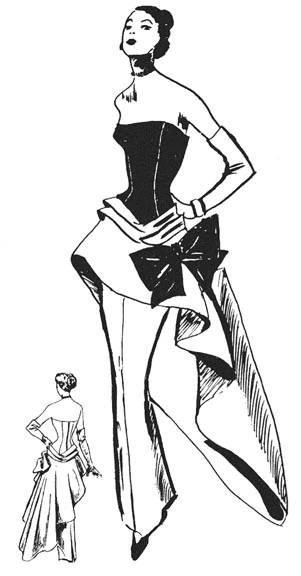
Modes Royale 1026; ca. 1951; Evening Dress. A dramatic, strapless gown with a fabulously draped tunic overskirt.
Prominent Designer Patterns and American Designer's Patterns
These mail-order companies became known during the 1950s and 1960s for offering designs from leading fashion names, including Oleg Cassini, Ceil Chapman, Don Loper, Estevez, David Crystal, and Mr. Blackwell. American Designer's Patterns later served as the foundation for what became the Spadea brand.

Prominent Designer M430; ca. 1970s; Bert Geiger's pretty pop-on is a day/evening/anytime delight of a dress. No zipper, buttons or fitting problems – just wrap and sash through side slits to hip the waist. Bare shoulders, deep folds above a surplice neckline, then a float of a skirt.
Simplicity
Simplicity built its reputation on producing patterns that were straightforward and accessible for home sewers. Rather than focusing primarily on high-fashion designs, the company reflected the clothing and household styles commonly found in everyday American life. As a result, vintage Simplicity patterns provide an important record of mainstream fashion trends throughout the twentieth century.
The company also introduced several special collections. During the 1930s, it released the Customode line, while the late 1940s and early 1950s saw the introduction of Simplicity Designer patterns, which featured larger packaging and more sophisticated styling than the standard range.
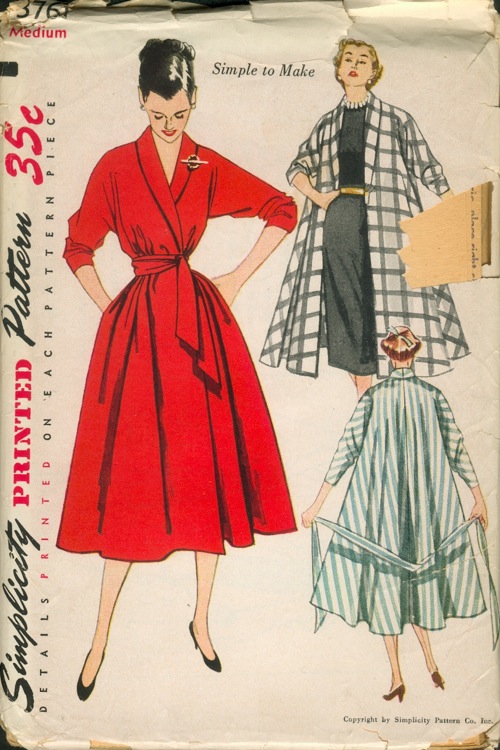
Simplicity 3761; ©1951; Misses' and Women's Coat Dress, Coat and Robe: This versatile style is cut in four sections. The shawl collar which may be turned up or down in the back is cut in one with the front. The push-up sleeves are cut in one with the back and front. The self fabric belt can be wrapped around the waistline twice and tied.
Spadea
Spadea operated as a mail-order pattern company and is highly regarded among collectors today. Numerous influential designers contributed to its catalogue during the 1950s and 1960s, including Ceil Chapman, Jo Copeland, Suzy Perette, and Lachasse of London. Original Spadea patterns are often considered among the most desirable examples of vintage designer sewing patterns.

Spadea 451; ©1961; Unprinted Pattern. Dinah Shore - Sheath. The beautifully shaped bodice of this basic sheath is sleeveless for candlelight hours, its skirt a slim line eased in front with released pleats and vented briefly at the hem for graceful movement.
Vogue Patterns
Vogue Patterns began in 1905 as a mail-order service connected to Vogue magazine. Throughout its history, the company has maintained a reputation for fashionable and forward-thinking designs. By the early 1930s, Vogue was already producing patterns inspired by leading couture houses, although these were not exact runway reproductions.
In 1949, the company launched its celebrated "Paris Originals" collection, featuring designs from prestigious fashion houses such as Balmain, Schiaparelli, Lanvin, and Jacques Fath. As fashion evolved during the 1960s, Vogue expanded its collaborations to include influential European designers including Yves Saint Laurent, Hubert de Givenchy, and Emilio Pucci.
The company introduced the Americana series in 1967, highlighting original work by prominent American designers such as Oscar de la Renta, Teal Traina, Geoffrey Beene, and Bill Blass. Later, in 1984, Vogue responded to the growing popularity of avant-garde fashion by launching its "Individualist" collection. Although these patterns are relatively modern, their limited production numbers have made them highly collectible, particularly those designed by Issey Miyake and Claude Montana.

Vogue Paris 1135; ca. 1974; Emanuel Ungaro - Misses' Evening Dress. Evening length dress has front bodice formed by two back panels pleated into wide, bias contour midriff (slightly above waistline at front and lower at back), gathered to criss-cross back straps and loops. Wide, full skirt is pleated into midriff; back zipper closing.